
Why Do Cockroaches Keep Coming Back?
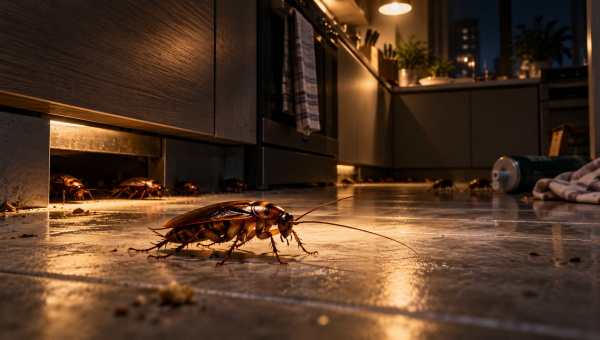
You walk into the kitchen at night. Something moves. You switch on the light.
Cockroach.
You grab the spray. Problem solved. Or so you think. The next evening, there's another one. Then another.
A few days later, you start wondering:
“How are they still here? I sprayed them.”
The uncomfortable answer is simple.
The cockroach you killed may only have been the one you could see.
And when it comes to a real cockroach infestation, killing the visible cockroach and controlling the infestation are two very different things.
Why Do Cockroaches Keep Coming Back After You Spray Them?
Because the cockroaches walking across your kitchen floor are only part of the problem.
Cockroaches spend much of their time hidden in protected areas such as:
-
cracks and crevices;
-
underneath appliances;
-
behind refrigerators;
-
inside cupboards;
-
around plumbing;
-
wall voids;
-
electrical equipment;
-
under sinks;
-
and other warm, dark or humid locations.
Victorian Department of Health guidance notes that cockroaches commonly hide in protected areas during the day and become active at night. German cockroaches in particular frequently establish themselves around kitchens, cupboards, sinks and electrical appliances.
So when one cockroach runs across the floor, you're seeing the animal that left the hiding place.
You're not necessarily seeing where the infestation is actually living.
The Cockroach You See Isn't Always the Problem
Imagine finding water leaking through your ceiling.
You could wipe the water off the floor.
But unless you find where it's coming from, you haven't solved the leak.
Cockroach control can be similar.
Killing individual cockroaches may reduce the number you see.
But if the conditions allowing them to survive remain untouched, the activity may continue.
Professional pest control therefore isn't simply about:
“How many cockroaches can we kill today?”
The more important question is:
“Why are they here, where are they hiding, and how do we interrupt the infestation?”
Cockroaches Don't Need Much Space to Hide
One reason cockroach infestations can be so frustrating is that they can hide in extremely small areas.
German cockroaches favour warm, protected harbourages and can squeeze into remarkably narrow cracks and crevices.
UC Integrated Pest Management notes that adult German cockroaches can shelter in cracks around 1/16 of an inch wide, while immature cockroaches can occupy even smaller spaces.
That's why you may never see where most of the activity is actually happening.
Behind the refrigerator may look perfectly normal.
Inside a small gap beside the cabinet?
Different story.
Then There Are the Eggs
This is where cockroach control becomes even more interesting.
Cockroaches don't simply produce individual exposed eggs.
Their eggs are enclosed inside a protective case known as an ootheca.
Depending on the species, that egg case may contain many developing cockroaches.
German cockroaches are particularly successful household pests because the female carries her egg case for most of its development, dropping it shortly before the young hatch. UC IPM notes that a German cockroach egg case can contain around 30 young.
Victorian health guidance reports that German cockroaches may produce up to around 40 offspring per generation and can develop from hatchling to adult in as little as approximately 40 days under favourable conditions.
That changes the way you should think about the cockroach you just sprayed.
You may have killed one adult.
But somewhere nearby there could be:
nymphs + hidden adults + egg cases + another generation developing.
Why One Spray Isn't Always the End of the Story
This does not mean sprays are useless.
Professional pest management can involve appropriately selected:
-
residual surface treatments;
-
crack-and-crevice treatments;
-
baits;
-
gels;
-
dusts;
-
monitoring;
-
sanitation recommendations;
-
and other control methods.
The right approach depends on the species, the location and the severity of the infestation.
Australian public-health guidance specifically recommends a combination of inspection, removal of food/water/shelter, appropriate pesticide or bait treatments, and follow-up monitoring for effective cockroach control.
That's very different from seeing one cockroach and covering the kitchen with whatever aerosol happens to be under the sink.
Spraying What You Can See May Miss Where They Live
This is one of the biggest differences.
A visible cockroach is easy to spray.
A cockroach hiding:
-
behind a fridge motor;
-
inside a cabinet hinge;
-
beneath an appliance;
-
in a narrow wall gap;
-
or deep inside a crevice
isn't.
And those protected harbourages are often where control efforts need to be focused.
Victorian health guidance specifically notes that space sprays may not effectively penetrate harbourages and that modern cockroach control increasingly makes use of targeted methods such as baits and dusts alongside appropriate treatments.
The goal isn't simply to make the room smell like pesticide.
The treatment needs to reach where the cockroaches actually travel, feed and hide.
The Cockroach Species Matters More Than You Think
Another reason DIY cockroach control can fail?
You may be treating the wrong cockroach in the wrong way.
Not all cockroaches behave the same.
Australia has several pest species, including:
-
German cockroaches;
-
American cockroaches;
-
Australian cockroaches;
-
smokybrown cockroaches;
-
brownbanded cockroaches;
-
and Oriental cockroaches.
Some primarily establish themselves indoors.
Others commonly live outside and enter buildings from external harbourages.
Some prefer kitchens.
Others may be associated with drains, roof voids, vegetation, subfloors or warmer areas higher inside the building.
Correct identification matters because the most effective inspection and treatment approach can change depending on the species involved.
A German Cockroach Problem Is Not Necessarily an Outdoor Cockroach Problem
German cockroaches are particularly associated with indoor infestations.
They are small, reproduce rapidly and commonly establish themselves around:
-
kitchens;
-
sinks;
-
cupboards;
-
drawers;
-
refrigerators;
-
and electrical appliances.
Larger species such as American or Australian cockroaches may be associated more strongly with external areas, drains, roof spaces, wall voids, vegetation and other environments.
So simply asking:
“What kills cockroaches?”
isn't necessarily enough.
A better question is:
“Which cockroach are we trying to control?”
Why Are You Suddenly Seeing Cockroaches During the Day?
Most pest cockroaches are predominantly active at night.
That's why the classic cockroach encounter happens when someone walks into the kitchen after dark and switches on the light.
But if you're regularly seeing cockroaches wandering openly during the daytime, pay attention.
Public-health guidance notes that daytime cockroach activity can be associated with a substantial infestation, although a single daytime sighting alone doesn't prove how large the population is.
It may indicate increased population pressure or disturbed harbourages.
Either way, repeated daytime sightings are worth investigating.
Food Isn't the Only Thing Keeping Them There
People often assume:
“My house is clean. I shouldn't have cockroaches.”
Unfortunately, it isn't that simple.
Cleanliness absolutely matters.
But cockroaches are incredibly good at exploiting small resources.
They need three basic things:
food + water + shelter.
And food doesn't necessarily mean a dirty dinner plate sitting on the floor.
It can be:
-
crumbs beneath an appliance;
-
grease behind a stove;
-
pet food;
-
residue around bins;
-
food inside cupboards;
-
organic debris;
-
or tiny amounts of material that are easy to overlook.
Water can come from:
-
leaking taps;
-
condensation;
-
sinks;
-
plumbing;
-
wet sponges;
-
appliance drip trays;
-
and other damp areas.
EPA and Australian health guidance both emphasise reducing food, water and shelter as important components of effective pest management.
You can treat cockroaches...
But if you continue providing them with everything they need to survive, you're making the job much harder.
The Fridge Can Be a Cockroach Paradise
Your refrigerator deserves special attention.
Think about what it provides.
Warmth.
The motor and mechanical components generate heat.
Darkness.
The area behind and underneath the appliance is rarely disturbed.
Shelter.
There are small gaps, components and crevices.
Food.
Crumbs can accumulate beneath the appliance.
Potential moisture.
Condensation and nearby plumbing can contribute.
German cockroaches are known to harbour around refrigerators and other electrical equipment.
So while you're looking across your clean kitchen bench wondering where the cockroaches are coming from...
The more useful place to investigate may be somewhere you haven't cleaned behind in two years.
And Then There's the Cardboard Box
Here's another way cockroaches can surprise you.
Sometimes they don't walk into the property.
You carry them in.
German cockroaches can spread between locations as stowaways in items such as cardboard boxes, crates and transported goods. Victorian health guidance notes that even a relatively small number introduced into a suitable environment can establish and reproduce quickly.
Think about how much cardboard enters an ordinary household:
Online shopping.
Food deliveries.
Appliance boxes.
Moving boxes.
Storage boxes.
Second-hand items.
That's why a cockroach problem doesn't always mean pests travelled across the garden and entered through the front door.
Sometimes the journey was much easier.
Why You May Still See Cockroaches After Professional Treatment
This is important.
Seeing a cockroach shortly after treatment does not automatically mean the treatment has failed.
Some professional control methods are intentionally not instantaneous.
Cockroach baits, for example, generally work more slowly than direct-contact sprays.
UC IPM notes that effective bait programs may take seven days or longer before a noticeable decline in cockroach numbers occurs.
That can feel strange to a customer.
You paid for pest control.
You see a cockroach two days later.
Your first reaction is:
“It didn't work.”
But depending on the treatment strategy, activity may need to be assessed over time.
What matters is whether the population and activity are declining and whether the treatment plan includes appropriate monitoring and follow-up where required.
Sometimes Follow-Up Is Part of Proper Cockroach Control
Cockroaches reproduce.
Eggs hatch.
Hidden insects emerge.
Conditions change.
That's why established infestations may require more than a one-off visit.
Australian public-health guidance includes follow-up inspection and monitoring as part of effective cockroach management.
That isn't necessarily because the first treatment “didn't work.”
It may be because pest control is targeting a living population with different life stages, not cleaning a stain off a surface.
The goal is to break the cycle.
What About Cockroach Bombs and Foggers?
This is another area where doing more doesn't automatically mean achieving more.
People sometimes assume that filling the entire room with insecticide must be more effective than targeted treatment.
But cockroaches spend much of their time inside protected harbourages.
UC IPM advises against relying on foggers or aerosol “bombs” for cockroach management, noting that they may disperse cockroaches without effectively controlling the infestation.
Effective treatment is usually much more strategic than simply putting as much chemical into the room as possible.
Pest control is about placement, biology and behaviour — not just volume.
Why Professional Pest Control Starts With Inspection
This is the part customers don't always see.
Before treatment, we want to understand:
What pest are we dealing with?
Where are you seeing it?
When are you seeing it?
How much activity is there?
Where could it be harbouring?
What is providing food, water or shelter?
Are there signs of eggs, droppings or nymphs?
Is this likely an indoor breeding population or an outdoor species entering the property?
Those questions help determine the appropriate treatment.
The spray bottle comes after the thinking.
Signs You May Have More Than One Cockroach
Seeing a live cockroach is the obvious sign.
But it isn't the only one.
During an inspection, other evidence can include:
-
cockroach droppings;
-
dark faecal marks or smears;
-
shed skins;
-
dead cockroaches;
-
egg cases;
-
juvenile cockroaches;
-
repeated nighttime sightings;
-
and activity around appliances or cupboards.
Health guidance specifically recommends looking for live or dead cockroaches, faecal material, cast skins and egg cases when investigating infestations.
And here's one particularly important sign:
Tiny Cockroaches
If you're seeing extremely small cockroaches, don't automatically assume they're a completely different insect.
They may be nymphs — immature cockroaches.
And if you've got young cockroaches appearing inside the property, that can indicate reproduction is occurring nearby.
That's a very different situation from one large outdoor cockroach accidentally wandering inside.
What Can Homeowners Do to Help Control Cockroaches?
Professional treatment works best when the property itself isn't working against it.
Remove Easy Food Sources
Clean food residue and grease.
Store food appropriately.
Don't leave dirty dishes sitting overnight.
Empty rubbish regularly.
Don't Forget Pet Food
Food and water left available overnight can provide another resource.
Fix Water Sources
Repair leaking taps and pipes where possible.
Dry persistent wet areas.
Check beneath sinks.
Reduce Clutter
Cockroaches love protected hiding locations.
Large amounts of cardboard and clutter can make inspection and control more difficult.
Seal Entry and Hiding Points
Where practical, cracks, gaps and other entry points can be addressed.
Follow Preparation Instructions
If your pest control technician asks you to prepare particular areas before treatment, there is usually a reason.
Proper access can make the treatment considerably more effective.
Don't Judge Cockroach Treatment by How Much Chemical You See
This may be one of the biggest misconceptions in pest control.
A customer sees someone spraying every visible centimetre of a room and thinks:
“They're really treating it properly.”
Another technician carefully treats specific cracks, harbourages and activity areas and appears to use less product.
The second technician may actually be taking the more targeted approach.
Effective pest management can use combinations of baits, targeted sprays, dusts, exclusion, sanitation and monitoring, depending on the situation.
More chemical does not automatically mean better pest control.
Knowing where, why and how to treat is what matters.
So Why Do Cockroaches Keep Coming Back?
Usually because the answer isn't simply:
“The spray wasn't strong enough.”
The real explanation may involve:
-
hidden harbourages;
-
untreated areas;
-
egg cases;
-
newly hatched nymphs;
-
available food;
-
available water;
-
incorrect species identification;
-
cockroaches entering from outside;
-
cockroaches being carried into the property;
-
ineffective DIY treatment;
-
or an established infestation requiring ongoing control.
Sometimes several of those things are happening at once.
That's why killing one cockroach isn't the same as solving a cockroach infestation.
The Cockroach You Killed Tonight May Have Been the Warning
So next time you walk into the kitchen...
Switch on the light...
And watch a cockroach disappear underneath the refrigerator...
Don't only ask:
“How do I kill that cockroach?”
Ask:
“Why is that cockroach here?”
Because the one running across the floor may simply be the pest that finally made the hidden problem visible.
And when you understand where they're living, what they're feeding on and how they're reproducing, you're much closer to controlling the infestation properly.
Need Cockroach Pest Control in Perth?
If cockroaches keep returning after DIY treatments, you're regularly seeing small cockroaches, or the activity appears to be increasing, it may be time to investigate the source rather than continuing to spray individual insects.
At Clean Carpets and Pest Control Perth, we assess the pest activity and determine an appropriate treatment approach based on the property and the problem we're dealing with.
Because effective cockroach control isn't simply about killing the cockroach you can see.
It's about controlling the ones you can't.
Contact Clean Carpets and Pest Control Perth to discuss your cockroach problem and pest control requirements.
Pest Control Perth | Cockroach Treatment Perth | Cockroach Pest Control | Professional Pest Control Perth
Article Author: Janus Oosthuizen
Date: 30 September 2026
Frequently Asked Questions
Why do cockroaches keep coming back after I spray them?
Visible cockroaches may represent only part of an infestation. Others can remain hidden in cracks, appliances, cupboards and other protected harbourages, while egg cases and immature cockroaches may also be present.
Does seeing one cockroach mean I have an infestation?
Not necessarily. One cockroach can occasionally enter a property from outside. However, repeated sightings, small nymphs, droppings, egg cases or cockroaches appearing during the day can justify further investigation.
Why am I seeing baby cockroaches in my kitchen?
Small cockroaches may be nymphs. Repeated sightings of nymphs indoors can indicate that cockroaches are reproducing somewhere nearby.
How long does cockroach treatment take to work?
It depends on the treatment method and severity of the infestation. Some bait treatments are deliberately slow acting and may take seven days or longer before activity noticeably declines.
Are cockroach bombs effective?
Foggers and bombs are not necessarily the best way to control an established infestation because they may not reach protected harbourages effectively. Targeted treatment and integrated pest-management methods are generally more effective approaches.
What attracts cockroaches to a house?
Food, moisture and suitable hiding places all support cockroach populations. Crumbs, grease, pet food, leaking plumbing, clutter and protected warm areas can contribute.
Should I call pest control if I see cockroaches during the day?
Repeated daytime activity can be associated with a significant cockroach population and is worth investigating, particularly when accompanied by nymphs, droppings or other evidence.
References
Victorian Department of Health — Cockroaches – Pest Control, updated 23 December 2024.
University of California Statewide Integrated Pest Management Program — Cockroaches: Identification, Behaviour and Management.
United States Environmental Protection Agency — Smart Pest Control to Protect Your Health.
Article Author: Janus Oosthuizen
Date: 2026-09-30